PATMOS: A Foolish, Unjust, and Immoral War
A
Admin
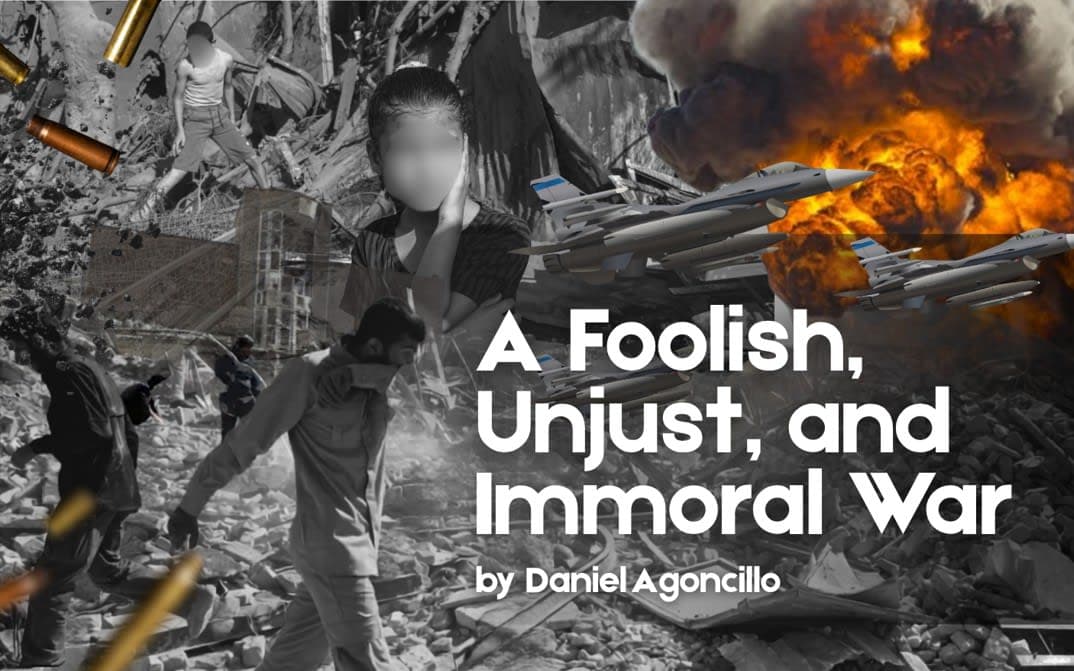
The world is now teetering on the brink of a nuclear war after the United States and Israel launched joint missile strikes against Iran, provoking retaliation from the latter that has resulted in tens of thousands killed and injured.
To date, air travel is crippled, prices of oil products are soaring and plans for a massive repatriation of overseas workers in the Middle East is underway, amid fears of an economic and political debacle of global proportions.
Among those killed as a result of the war were Iranian Supreme Leader Ayatollah Ali Khamenei and members of his family; at least 47 top Iranian leaders; 13 US servicemen, including a Filipino-American soldier; a Filipino caregiver; and 180 Iranians, mostly pupils and teachers, at an elementary school for girls.
US President Donald Trump has announced that the war would likely continue for four or five more weeks but that America was prepared should it take much longer.
Responding to counterstrikes by Tehran on Israel and Arab neighbor states hosting US military bases and the consequent deaths of US servicemen, Trump has vowed to "hit them with a force that has never been seen before." He has not ruled out the deployment of ground troops or the use of nuclear weapons.
Leaders of nation states in Europe, Asia and Latin America have since condemned the attacks.
A recent Reuters Ipsos survey shows that three out of four Americans disagreed with the war and that 42 percent of Republican voters were inclined to withdraw support if it meant more US soldiers in the Middle East would be killed or injured.
But why wage war? In separate media interviews and social media posts, US President Donald Trump, Israeli Prime Minister Benjamin Netanyahu and their respective cabinet officials said the war aimed to help Iranian opposition forces replace the corrupt and repressive Khamenei regime with a democratic government.
According to them, the war also aimed to prevent Iran from doing the following:
. create intercontinental ballistic missiles that could reach and destroy the US;
· create nuclear weapons for use against Israel and its allies;
. support terrorist groups in the Middle East and other parts of the world; and
. block, or attempt to block, Trump's victory in US elections. (According to Trump, this happened in 2020 and 2024.)
"It's very simple," US Vice President JD Vance explained. "I think most Americans understand that you can't nuclear weapons."
Ironically, it was the US that encouraged Iran to develop nuclear capability in 1957, when then US President Dwight Eisenhower and Mohammad Reza Pahlavi, Shah of Iran and a known US ally, signed a civil nuclear cooperation agreement under the US Atoms for Peace Program. This led to the construction of nuclear research facilities and eventually, a nuclear power plant.
But Iran's nuclear program came to a halt following the 1979 Islamic revolution that ousted Pahlavi's corrupt, dictatorial, and US-backed regime and installed the Islamic fundamentalist rule of Ayatollah Ruhollah Khomeini.
Viewed as an evil influence from the West, the eight-year Iran-Iraq war shelved Iran's nuclear program and eventually destroyed it completely. When Ali Hosseini Khamenei assumed power in 1989, Iran revived and developed its nuclear program with the help of Russia and China.
In 2005, the Middle Eastern country came under pressure to stop developing nuclear capability from the International Atomic Energy Agency of the United Nations, as well as the US, Israel, and Western European nations. A year later, the UN Security Council imposed economic sanctions on Iran.
The sanctions eased somewhat in 2015 after Iran signed a deal with the US, China, and four European countries to limit its nuclear development.
But during his first term, Trump unilaterally withdrew from the deal and campaigned for a strict reimposition of sanctions. Since then, Iran has begun stockpiling enriched uranium.
Trump wrote Khameinei in April 2025, seeking nuclear disarmament negotiations and imposing a two-month deadline for finalizing a deal. When the deadline lapsed without an agreement, Israel attacked Iran, sparking a 12-day war that led to a suspension of negotiations. On June 22, 2025, the US attacked nuclear sites in Iran and, according to Trump, "obliterated" Iran's nuclear capability.
Early this year, Iran resumed negotiations with the US after a series of violent protests in its backyard, partly sparked by UN economic sanctions. According to mediators, Iran had already agreed to surrender its entire uranium stockpile but refused to reduce its ballistic missile capability. The US-Israeli attacks began just as negotiations were about to resume.
How big a threat to world peace is Iran? A New York Times report cited the following facts:
Iran has around 2,000 short- and medium-range ballistic missiles that can be used to strike at Israeli and US military bases in the Middle East, as well as sites in Central and Eastern Europe. But according to the Defense Intelligence Agency of the US, Iran has no intercontinental ballistic missiles (ICBMs) that can hit the US, and it might take as long as 10 years for it to construct ICBMs for this purpose.
A ballistic missile is a rocket-propelled projectile that drops on its target under the force of gravity. It is different from a regular missile that is guided to its target via computer programming.
Most of Iran's 60-percent enriched uranium supply, which can be converted into nuclear warheads, is buried at Isfahan, according to the International Atomic Energy Agency (IAEA) of the United Nations. But there is little to prove that Iran has been digging up the uranium. In its present state, the uranium has to first be enriched by 90 percent before it can be converted into effective nuclear weapons, a process that US officials and international weapons inspectors say could take more than a year to complete per warhead. This, they add, doesn't include the time and effort needed to attach a warhead to a rocket.
According to the International Campaign to Abolish Nuclear Weapons (ICAN) of the United Nations, around 90 percent of the world's nuclear warheads, totaling 12,331, are in the hands of just two countries: Russia with 5,459 and the United States with 5,277. The other seven countries with nuclear warheads are China, 600; France, 290; the United Kingdom, 225; India, 180; Pakistan, 170; Israel, 90; and North Korea, 50.
According to ICAN, a total of six nation-states without nuclear war capability are known to be serving as hosts of other countries' nuclear warheads. These are Italy, 35; Turkey, 20; Belgium, Germany, and the Belarus, with an undetermined number.
Iran has no nuclear warheads and is not hosting any. Israel is the only country in the Middle East with nuclear capability, possessing 90 ready-to-use warheads. In his State of the Union Address last February 24, Trump justified US strikes by claiming that Iran was close to acquiring nuclear capability, and declared that the US had "obliterated" Iran's nuclear program. He also said that Iran is "starting it all over" in building its nuclear weapons . However, Mr. Trump has yet to explain how their "obliterated" program can be rebuilt from scratch in just a matter of weeks.
So what are the real motives behind this war? In his opinion column in BusinessWorld, analyst Bienvenido Oplas cites data from the IMF World Economic Outlook 2025 report indicating that the US is pursuing regime change in Iran and other parts of the world in pursuit of its interest in global oil and gas reserves.
According to the report, Iran has the second largest oil reserves in the Middle East and the fourth largest in the world, with 158 billion barrels. The Islamic State also has the largest gas reserves in the Middle East and the second largest in the world, with 32 billion cubic meters (bcm).
Based on the oil reserves/production (R/P) ratio, showing the number of years before a country's reserves are depleted if current production rates continue, Iran is fourth in the world with 140 years, while the US has only 11 years. Iran ranks third globally with a gas R/P ratio of 128 years, compared to the US's 14 years.
The sanctions imposed on Iran restrict it to selling most of its oil to China and its gas to Iraq and Turkey. The US earlier took control of Venezuela's oil industry by abducting its President, Nicolas Maduro, and having him replaced by its Vice President, Delcy Rodriguez. It aims to replicate this in Iran by conducting a short war and installing a leader it could control.
Trump has called for the Middle Eastern country's unconditional surrender. But Iranian President Masoud Pezeshkian rejected this, saying Iran's enemies "must take their dream of the Iranian people's unconditional surrender to their graves."
Iranians remain divided over support for their government, which is known to be corrupt and repressive. But there are no indications that it will be toppled or replaced via US and Israeli airstrikes.
It is not a coincidence that US betting platforms, one of them linked to the US President's son, Donald Jr., made millions of dollars in profits by cashing in on predictions that the war would take place and Khameini would be replaced on February 28, 24 hours before these incidents occurred.
According to reports from Reuters and Bloomberg, gamblers associated with six accounts on the Polymarket and Kalshi platforms cashed in on bets predicting the exact date for the attacks on Iran and Khameini's removal from office.
According to the reports, an account trading under the username "Magamyman" made more than $553,000 by placing an $87,000 bet on the predictions, and an estimated $500 million was traded over the same prediction on Polymarket alone.
Most of these accounts were funded within 24 hours of the predicted events, and each purchased shares at around a dime apiece just before the bombing. Apparently the gamblers were given insider information at least 24 hours ahead of schedule.
Donald Jr. has been identified as a Polymarket adviser, and his venture capital company, 1789 Capital, is known to have invested millions in Polymarket.
The Trump administration earlier shut down two federal investigations on Polymarket and other platforms that the administration of former US President Joseph Biden had initiated.
Before his latest State of the Union address, a CNN poll showed Trump's approval rating had fallen significantly, from 48 percent in February 2025 to just 36 percent in February 2026. Based on the same poll, Americans who say the US President had the wrong priorities made up 68%, and those who say he was taking the country in the wrong direction made up 61%.
Political observers point out that Trump must win a majority in upcoming congressional elections to be able to continue pursuing his agenda for the next two years, or he ends up becoming a lame duck. To survive low poll ratings, he must continue doing what his predecessors did: kowtow to the US Jewish banking and entertainment industry that identifies with Israel.
Trump is also facing a scandal over mounting evidence that he had sex with child and teenage prostitutes from Jeffrey Epstein's sex trafficking operation. He has yet to show evidence that Iran had manipulated US elections.
Netanyahu, on the other hand, is trying to live down negative publicity arising from cases of fraud, breach of trust, and receiving of bribes filed against him that remain pending before Israeli courts.
From this perspective, it seems that the war serves as a strategy to distract the public from Trump and Netanyahu's political and public relations challenges.
As it stands, and in light of all of the relevant facts about it, this war and its consequences are raising serious questions that demand immediate answers. First, should leaders of nation-states launch military attacks against, and assassinate leaders of, other nation-states while engaging in peace negotiations with them? Second, should nations with nuclear weapons compel other nation-states without them to stop developing these weapons while maintaining their stockpile of warheads? Third, should the United Nations and its agencies apply pressure on countries like Iran so they would stop developing nuclear weapons but allow countries like the US and Israel to keep their ready-made warheads for use against perceived enemies? Fourth, should nation-states with no nuclear weapons defend themselves against nation-states that have them? If so, how? Fifth, should a nation-state wage war to bring down the government of another nation-state so it can acquire its precious natural resources? Lastly, should this war continue?
Daniel Agoncillo
is a call center agent who has worked as an editor in various newspapers for 17 years. He occasionally writes for the Institute for Studies in Asian Church and Culture (ISACC).
Agiesta, J., Edwards-Levy, A., & Wu, E. (2026, January 16). Trump economy first-year CNN poll. CNN. https://edition.cnn.com/2026/01/16/politics/trump-economy-first-year-cnn-poll
Berdnikova, S., Noryskiewicz, A., Stretch, A., Ott, H., Lyons, E., Zargar, A., & Andrews, F. (2026, March 12). U.S .- Iran war: How other countries view Middle East conflict. CBS News. https://www.cbsnews.com/news/us-iran-war-israel-how-other-countries-view-middle-east-conflict/
Bush, D., & Ireland, O. (2026, March 7). Trump demands "unconditional surrender" from Iran as Putin speaks with Iran's president. BBC News. https://www.bbc.com/news/articles/c5yq82klwk8o
Cortellessa, E. (2026, March 6). Trump's war. Time. https://time.com/7382697/trump-iran-war/
Habibiazad, G., & McGarvey, E. (2026). Iranians deeply divided over Mojtaba Khamenei's rise to power. BBC News https://www.bbc.com/news/articles/cwy8ldyp2zwo
Lange, J. (2026, March 1). Just one in four Americans support U.S. strikes on Iran, Reuters/Ipsos poll finds. Reuters. https://www.reuters.com/world/us/just-one-four-americans-support-us-strikes-iran-reutersipsos-poll-finds-2026-03-01/
Mazzetti, M., Wong, E., Sanger, D. E., & Barnes, J. E. (2026, February 26). Trump Iran claims nuclear weapons. The New York Times. https://www.nytimes.com/2026/02/26/us/politics/trump-iran-claims-nuclear-weapons.html
McEntyre, N. (2026). Trump warns Iran not to retaliate after threats of devastating attack. MSN. https://www.msn.com/en-us/news/world/trump-warns-iran-not-to-retaliate-after-threats-of-devastating-attack/ar-AAlXiIRf
Nicolle, E. (2026, March 1). Polymarket Iran bets hit $529 million as new wallets draw notice. Bloomberg. https://www.bloomberg.com/news/articles/2026-02-28/polymarket-iran-bets-hit-529-million-as-new-wallets-draw-notice
Oplas, B. S., Jr. (2026, March 3). On the Iran war, energy, and economic implications. BusinessWorld Online. https://www.bworldonline.com/opinion/2026/03/03/733665/on-the-iran-war-energy-and-economic-implications/
Roth, A. (2026, February 26). Trump once boasted about opposing the Iraq war, but Iran shows his stance on foreign conflicts is ever shifting. The Guardian. https://www.theguardian.com/us-news/2026/feb/26/trump-foreign-wars-iran
Sherman, N. (2026, January 6). US will control Venezuela oil sales "indefinitely", official says. BBC News. https://www.bbc.com/news/articles/ckgn7p7g79wo
Smith, D. (2026, March 2). Trump says Iran war to last four to five weeks but could go "far longer". The Guardian. https://www.theguardian.com/us-news/2026/mar/02/trump-war-iran
Sweet, J., & Gedeon, J. (2026, February 26). Epstein files contain explicit but unsubstantiated claim that Trump abused minor. The Guardian. https://www.theguardian.com/us-news/2026/feb/26/trump-epstein-files-fbi
Tondo, L., & Burke, J. (2026, March 7). Iran rejects Trump's demand for unconditional surrender as a "dream". The Guardian. https://www.theguardian.com/world/2026/mar/07/iran-trump-unconditional-surrender-war-masoud-pezeshkian
Westbrook, T. (2026, March 2). Prediction markets scrutinised over Iran bets. Reuters. https://www.reuters.com/world/middle-east/prediction-markets-scrutinised-over-iran-bets-2026-03-02/
Wikipedia contributors. (n.d.). 2025-2026 Iran-United States negotiations. In Wikipedia. Wikipedia contributors. (n.d.). 2025-2026 Iran-United States negotiations. Wikipedia. https://en.wikipedia.org/wiki/2025%E2%80%932026_Iran%E2%80%93United_States_negotiations
Wikipedia contributors. (n.d.). Nuclear program of Iran. In Wikipedia. Wikipedia contributors. (n.d.). Nuclear program of Iran. Wikipedia. https://en.wikipedia.org/wiki/Nuclear_program_of_Iran
Wikipedia contributors. (n.d.). Timeline of the nuclear program of Iran. In Wikipedia. Wikipedia contributors. (n.d.). Timeline of the nuclear program of Iran. Wikipedia. https://en.wikipedia.org/wiki/Timeline_of_the_nuclear_program_of_Iran
Zvulun, R. (2025, December 1). Explainer: Netanyahu's corruption trial divides Israeli public. Al-Monitor. https://www.al-monitor.com/originals/2025/12/explainer-netanyahus-corruption-trial-divides-israeli-public
The world is now teetering on the brink of a nuclear war after the United States and Israel launched joint missile strikes against Iran, provoking retaliation from the latter that has resulted in tens of thousands killed and injured.
To date, air travel is crippled, prices of oil products are soaring and plans for a massive repatriation of overseas workers in the Middle East is underway, amid fears of an economic and political debacle of global proportions.
Among those killed as a result of the war were Iranian Supreme Leader Ayatollah Ali Khamenei and members of his family; at least 47 top Iranian leaders; 13 US servicemen, including a Filipino-American soldier; a Filipino caregiver; and 180 Iranians, mostly pupils and teachers, at an elementary school for girls.
US President Donald Trump has announced that the war would likely continue for four or five more weeks but that America was prepared should it take much longer.
Responding to counterstrikes by Tehran on Israel and Arab neighbor states hosting US military bases and the consequent deaths of US servicemen, Trump has vowed to "hit them with a force that has never been seen before." He has not ruled out the deployment of ground troops or the use of nuclear weapons.
Leaders of nation states in Europe, Asia and Latin America have since condemned the attacks.
A recent Reuters Ipsos survey shows that three out of four Americans disagreed with the war and that 42 percent of Republican voters were inclined to withdraw support if it meant more US soldiers in the Middle East would be killed or injured.
But why wage war? In separate media interviews and social media posts, US President Donald Trump, Israeli Prime Minister Benjamin Netanyahu and their respective cabinet officials said the war aimed to help Iranian opposition forces replace the corrupt and repressive Khamenei regime with a democratic government.
According to them, the war also aimed to prevent Iran from doing the following:
. create intercontinental ballistic missiles that could reach and destroy the US;
· create nuclear weapons for use against Israel and its allies;
. support terrorist groups in the Middle East and other parts of the world; and
. block, or attempt to block, Trump's victory in US elections. (According to Trump, this happened in 2020 and 2024.)
"It's very simple," US Vice President JD Vance explained. "I think most Americans understand that you can't nuclear weapons."
Ironically, it was the US that encouraged Iran to develop nuclear capability in 1957, when then US President Dwight Eisenhower and Mohammad Reza Pahlavi, Shah of Iran and a known US ally, signed a civil nuclear cooperation agreement under the US Atoms for Peace Program. This led to the construction of nuclear research facilities and eventually, a nuclear power plant.
But Iran's nuclear program came to a halt following the 1979 Islamic revolution that ousted Pahlavi's corrupt, dictatorial, and US-backed regime and installed the Islamic fundamentalist rule of Ayatollah Ruhollah Khomeini.
Viewed as an evil influence from the West, the eight-year Iran-Iraq war shelved Iran's nuclear program and eventually destroyed it completely. When Ali Hosseini Khamenei assumed power in 1989, Iran revived and developed its nuclear program with the help of Russia and China.
In 2005, the Middle Eastern country came under pressure to stop developing nuclear capability from the International Atomic Energy Agency of the United Nations, as well as the US, Israel, and Western European nations. A year later, the UN Security Council imposed economic sanctions on Iran.
The sanctions eased somewhat in 2015 after Iran signed a deal with the US, China, and four European countries to limit its nuclear development.
But during his first term, Trump unilaterally withdrew from the deal and campaigned for a strict reimposition of sanctions. Since then, Iran has begun stockpiling enriched uranium.
Trump wrote Khameinei in April 2025, seeking nuclear disarmament negotiations and imposing a two-month deadline for finalizing a deal. When the deadline lapsed without an agreement, Israel attacked Iran, sparking a 12-day war that led to a suspension of negotiations. On June 22, 2025, the US attacked nuclear sites in Iran and, according to Trump, "obliterated" Iran's nuclear capability.
Early this year, Iran resumed negotiations with the US after a series of violent protests in its backyard, partly sparked by UN economic sanctions. According to mediators, Iran had already agreed to surrender its entire uranium stockpile but refused to reduce its ballistic missile capability. The US-Israeli attacks began just as negotiations were about to resume.
How big a threat to world peace is Iran? A New York Times report cited the following facts:
Iran has around 2,000 short- and medium-range ballistic missiles that can be used to strike at Israeli and US military bases in the Middle East, as well as sites in Central and Eastern Europe. But according to the Defense Intelligence Agency of the US, Iran has no intercontinental ballistic missiles (ICBMs) that can hit the US, and it might take as long as 10 years for it to construct ICBMs for this purpose.
A ballistic missile is a rocket-propelled projectile that drops on its target under the force of gravity. It is different from a regular missile that is guided to its target via computer programming.
Most of Iran's 60-percent enriched uranium supply, which can be converted into nuclear warheads, is buried at Isfahan, according to the International Atomic Energy Agency (IAEA) of the United Nations. But there is little to prove that Iran has been digging up the uranium. In its present state, the uranium has to first be enriched by 90 percent before it can be converted into effective nuclear weapons, a process that US officials and international weapons inspectors say could take more than a year to complete per warhead. This, they add, doesn't include the time and effort needed to attach a warhead to a rocket.
According to the International Campaign to Abolish Nuclear Weapons (ICAN) of the United Nations, around 90 percent of the world's nuclear warheads, totaling 12,331, are in the hands of just two countries: Russia with 5,459 and the United States with 5,277. The other seven countries with nuclear warheads are China, 600; France, 290; the United Kingdom, 225; India, 180; Pakistan, 170; Israel, 90; and North Korea, 50.
According to ICAN, a total of six nation-states without nuclear war capability are known to be serving as hosts of other countries' nuclear warheads. These are Italy, 35; Turkey, 20; Belgium, Germany, and the Belarus, with an undetermined number.
Iran has no nuclear warheads and is not hosting any. Israel is the only country in the Middle East with nuclear capability, possessing 90 ready-to-use warheads. In his State of the Union Address last February 24, Trump justified US strikes by claiming that Iran was close to acquiring nuclear capability, and declared that the US had "obliterated" Iran's nuclear program. He also said that Iran is "starting it all over" in building its nuclear weapons . However, Mr. Trump has yet to explain how their "obliterated" program can be rebuilt from scratch in just a matter of weeks.
So what are the real motives behind this war? In his opinion column in BusinessWorld, analyst Bienvenido Oplas cites data from the IMF World Economic Outlook 2025 report indicating that the US is pursuing regime change in Iran and other parts of the world in pursuit of its interest in global oil and gas reserves.
According to the report, Iran has the second largest oil reserves in the Middle East and the fourth largest in the world, with 158 billion barrels. The Islamic State also has the largest gas reserves in the Middle East and the second largest in the world, with 32 billion cubic meters (bcm).
Based on the oil reserves/production (R/P) ratio, showing the number of years before a country's reserves are depleted if current production rates continue, Iran is fourth in the world with 140 years, while the US has only 11 years. Iran ranks third globally with a gas R/P ratio of 128 years, compared to the US's 14 years.
The sanctions imposed on Iran restrict it to selling most of its oil to China and its gas to Iraq and Turkey. The US earlier took control of Venezuela's oil industry by abducting its President, Nicolas Maduro, and having him replaced by its Vice President, Delcy Rodriguez. It aims to replicate this in Iran by conducting a short war and installing a leader it could control.
Trump has called for the Middle Eastern country's unconditional surrender. But Iranian President Masoud Pezeshkian rejected this, saying Iran's enemies "must take their dream of the Iranian people's unconditional surrender to their graves."
Iranians remain divided over support for their government, which is known to be corrupt and repressive. But there are no indications that it will be toppled or replaced via US and Israeli airstrikes.
It is not a coincidence that US betting platforms, one of them linked to the US President's son, Donald Jr., made millions of dollars in profits by cashing in on predictions that the war would take place and Khameini would be replaced on February 28, 24 hours before these incidents occurred.
According to reports from Reuters and Bloomberg, gamblers associated with six accounts on the Polymarket and Kalshi platforms cashed in on bets predicting the exact date for the attacks on Iran and Khameini's removal from office.
According to the reports, an account trading under the username "Magamyman" made more than $553,000 by placing an $87,000 bet on the predictions, and an estimated $500 million was traded over the same prediction on Polymarket alone.
Most of these accounts were funded within 24 hours of the predicted events, and each purchased shares at around a dime apiece just before the bombing. Apparently the gamblers were given insider information at least 24 hours ahead of schedule.
Donald Jr. has been identified as a Polymarket adviser, and his venture capital company, 1789 Capital, is known to have invested millions in Polymarket.
The Trump administration earlier shut down two federal investigations on Polymarket and other platforms that the administration of former US President Joseph Biden had initiated.
Before his latest State of the Union address, a CNN poll showed Trump's approval rating had fallen significantly, from 48 percent in February 2025 to just 36 percent in February 2026. Based on the same poll, Americans who say the US President had the wrong priorities made up 68%, and those who say he was taking the country in the wrong direction made up 61%.
Political observers point out that Trump must win a majority in upcoming congressional elections to be able to continue pursuing his agenda for the next two years, or he ends up becoming a lame duck. To survive low poll ratings, he must continue doing what his predecessors did: kowtow to the US Jewish banking and entertainment industry that identifies with Israel.
Trump is also facing a scandal over mounting evidence that he had sex with child and teenage prostitutes from Jeffrey Epstein's sex trafficking operation. He has yet to show evidence that Iran had manipulated US elections.
Netanyahu, on the other hand, is trying to live down negative publicity arising from cases of fraud, breach of trust, and receiving of bribes filed against him that remain pending before Israeli courts.
From this perspective, it seems that the war serves as a strategy to distract the public from Trump and Netanyahu's political and public relations challenges.
As it stands, and in light of all of the relevant facts about it, this war and its consequences are raising serious questions that demand immediate answers. First, should leaders of nation-states launch military attacks against, and assassinate leaders of, other nation-states while engaging in peace negotiations with them? Second, should nations with nuclear weapons compel other nation-states without them to stop developing these weapons while maintaining their stockpile of warheads? Third, should the United Nations and its agencies apply pressure on countries like Iran so they would stop developing nuclear weapons but allow countries like the US and Israel to keep their ready-made warheads for use against perceived enemies? Fourth, should nation-states with no nuclear weapons defend themselves against nation-states that have them? If so, how? Fifth, should a nation-state wage war to bring down the government of another nation-state so it can acquire its precious natural resources? Lastly, should this war continue?
Daniel Agoncillo
is a call center agent who has worked as an editor in various newspapers for 17 years. He occasionally writes for the Institute for Studies in Asian Church and Culture (ISACC).
Agiesta, J., Edwards-Levy, A., & Wu, E. (2026, January 16). Trump economy first-year CNN poll. CNN. https://edition.cnn.com/2026/01/16/politics/trump-economy-first-year-cnn-poll
Berdnikova, S., Noryskiewicz, A., Stretch, A., Ott, H., Lyons, E., Zargar, A., & Andrews, F. (2026, March 12). U.S .- Iran war: How other countries view Middle East conflict. CBS News. https://www.cbsnews.com/news/us-iran-war-israel-how-other-countries-view-middle-east-conflict/
Bush, D., & Ireland, O. (2026, March 7). Trump demands "unconditional surrender" from Iran as Putin speaks with Iran's president. BBC News. https://www.bbc.com/news/articles/c5yq82klwk8o
Cortellessa, E. (2026, March 6). Trump's war. Time. https://time.com/7382697/trump-iran-war/
Habibiazad, G., & McGarvey, E. (2026). Iranians deeply divided over Mojtaba Khamenei's rise to power. BBC News https://www.bbc.com/news/articles/cwy8ldyp2zwo
Lange, J. (2026, March 1). Just one in four Americans support U.S. strikes on Iran, Reuters/Ipsos poll finds. Reuters. https://www.reuters.com/world/us/just-one-four-americans-support-us-strikes-iran-reutersipsos-poll-finds-2026-03-01/
Mazzetti, M., Wong, E., Sanger, D. E., & Barnes, J. E. (2026, February 26). Trump Iran claims nuclear weapons. The New York Times. https://www.nytimes.com/2026/02/26/us/politics/trump-iran-claims-nuclear-weapons.html
McEntyre, N. (2026). Trump warns Iran not to retaliate after threats of devastating attack. MSN. https://www.msn.com/en-us/news/world/trump-warns-iran-not-to-retaliate-after-threats-of-devastating-attack/ar-AAlXiIRf
Nicolle, E. (2026, March 1). Polymarket Iran bets hit $529 million as new wallets draw notice. Bloomberg. https://www.bloomberg.com/news/articles/2026-02-28/polymarket-iran-bets-hit-529-million-as-new-wallets-draw-notice
Oplas, B. S., Jr. (2026, March 3). On the Iran war, energy, and economic implications. BusinessWorld Online. https://www.bworldonline.com/opinion/2026/03/03/733665/on-the-iran-war-energy-and-economic-implications/
Roth, A. (2026, February 26). Trump once boasted about opposing the Iraq war, but Iran shows his stance on foreign conflicts is ever shifting. The Guardian. https://www.theguardian.com/us-news/2026/feb/26/trump-foreign-wars-iran
Sherman, N. (2026, January 6). US will control Venezuela oil sales "indefinitely", official says. BBC News. https://www.bbc.com/news/articles/ckgn7p7g79wo
Smith, D. (2026, March 2). Trump says Iran war to last four to five weeks but could go "far longer". The Guardian. https://www.theguardian.com/us-news/2026/mar/02/trump-war-iran
Sweet, J., & Gedeon, J. (2026, February 26). Epstein files contain explicit but unsubstantiated claim that Trump abused minor. The Guardian. https://www.theguardian.com/us-news/2026/feb/26/trump-epstein-files-fbi
Tondo, L., & Burke, J. (2026, March 7). Iran rejects Trump's demand for unconditional surrender as a "dream". The Guardian. https://www.theguardian.com/world/2026/mar/07/iran-trump-unconditional-surrender-war-masoud-pezeshkian
Westbrook, T. (2026, March 2). Prediction markets scrutinised over Iran bets. Reuters. https://www.reuters.com/world/middle-east/prediction-markets-scrutinised-over-iran-bets-2026-03-02/
Wikipedia contributors. (n.d.). 2025-2026 Iran-United States negotiations. In Wikipedia. Wikipedia contributors. (n.d.). 2025-2026 Iran-United States negotiations. Wikipedia. https://en.wikipedia.org/wiki/2025%E2%80%932026_Iran%E2%80%93United_States_negotiations
Wikipedia contributors. (n.d.). Nuclear program of Iran. In Wikipedia. Wikipedia contributors. (n.d.). Nuclear program of Iran. Wikipedia. https://en.wikipedia.org/wiki/Nuclear_program_of_Iran
Wikipedia contributors. (n.d.). Timeline of the nuclear program of Iran. In Wikipedia. Wikipedia contributors. (n.d.). Timeline of the nuclear program of Iran. Wikipedia. https://en.wikipedia.org/wiki/Timeline_of_the_nuclear_program_of_Iran
Zvulun, R. (2025, December 1). Explainer: Netanyahu's corruption trial divides Israeli public. Al-Monitor. https://www.al-monitor.com/originals/2025/12/explainer-netanyahus-corruption-trial-divides-israeli-public

By The late Evelyn Miranda Feliciano

By Denise Ganalon, Jerome Bonita, Elizabeth Taturevych & Danica Quijano

By Caleb Maglaya Galaraga
The world is now teetering on the brink of a nuclear war after the United States and Israel launched joint missile strikes against Iran, provoking retaliation from the latter that has resulted in tens of thousands killed and injured.
To date, air travel is crippled, prices of oil products are soaring and plans for a massive repatriation of overseas workers in the Middle East is underway, amid fears of an economic and political debacle of global proportions.
Among those killed as a result of the war were Iranian Supreme Leader Ayatollah Ali Khamenei and members of his family; at least 47 top Iranian leaders; 13 US servicemen, including a Filipino-American soldier; a Filipino caregiver; and 180 Iranians, mostly pupils and teachers, at an elementary school for girls.
US President Donald Trump has announced that the war would likely continue for four or five more weeks but that America was prepared should it take much longer.
Responding to counterstrikes by Tehran on Israel and Arab neighbor states hosting US military bases and the consequent deaths of US servicemen, Trump has vowed to "hit them with a force that has never been seen before." He has not ruled out the deployment of ground troops or the use of nuclear weapons.
Leaders of nation states in Europe, Asia and Latin America have since condemned the attacks.
A recent Reuters Ipsos survey shows that three out of four Americans disagreed with the war and that 42 percent of Republican voters were inclined to withdraw support if it meant more US soldiers in the Middle East would be killed or injured.
But why wage war? In separate media interviews and social media posts, US President Donald Trump, Israeli Prime Minister Benjamin Netanyahu and their respective cabinet officials said the war aimed to help Iranian opposition forces replace the corrupt and repressive Khamenei regime with a democratic government.
According to them, the war also aimed to prevent Iran from doing the following:
. create intercontinental ballistic missiles that could reach and destroy the US;
· create nuclear weapons for use against Israel and its allies;
. support terrorist groups in the Middle East and other parts of the world; and
. block, or attempt to block, Trump's victory in US elections. (According to Trump, this happened in 2020 and 2024.)
"It's very simple," US Vice President JD Vance explained. "I think most Americans understand that you can't nuclear weapons."
Ironically, it was the US that encouraged Iran to develop nuclear capability in 1957, when then US President Dwight Eisenhower and Mohammad Reza Pahlavi, Shah of Iran and a known US ally, signed a civil nuclear cooperation agreement under the US Atoms for Peace Program. This led to the construction of nuclear research facilities and eventually, a nuclear power plant.
But Iran's nuclear program came to a halt following the 1979 Islamic revolution that ousted Pahlavi's corrupt, dictatorial, and US-backed regime and installed the Islamic fundamentalist rule of Ayatollah Ruhollah Khomeini.
Viewed as an evil influence from the West, the eight-year Iran-Iraq war shelved Iran's nuclear program and eventually destroyed it completely. When Ali Hosseini Khamenei assumed power in 1989, Iran revived and developed its nuclear program with the help of Russia and China.
In 2005, the Middle Eastern country came under pressure to stop developing nuclear capability from the International Atomic Energy Agency of the United Nations, as well as the US, Israel, and Western European nations. A year later, the UN Security Council imposed economic sanctions on Iran.
The sanctions eased somewhat in 2015 after Iran signed a deal with the US, China, and four European countries to limit its nuclear development.
But during his first term, Trump unilaterally withdrew from the deal and campaigned for a strict reimposition of sanctions. Since then, Iran has begun stockpiling enriched uranium.
Trump wrote Khameinei in April 2025, seeking nuclear disarmament negotiations and imposing a two-month deadline for finalizing a deal. When the deadline lapsed without an agreement, Israel attacked Iran, sparking a 12-day war that led to a suspension of negotiations. On June 22, 2025, the US attacked nuclear sites in Iran and, according to Trump, "obliterated" Iran's nuclear capability.
Early this year, Iran resumed negotiations with the US after a series of violent protests in its backyard, partly sparked by UN economic sanctions. According to mediators, Iran had already agreed to surrender its entire uranium stockpile but refused to reduce its ballistic missile capability. The US-Israeli attacks began just as negotiations were about to resume.
How big a threat to world peace is Iran? A New York Times report cited the following facts:
Iran has around 2,000 short- and medium-range ballistic missiles that can be used to strike at Israeli and US military bases in the Middle East, as well as sites in Central and Eastern Europe. But according to the Defense Intelligence Agency of the US, Iran has no intercontinental ballistic missiles (ICBMs) that can hit the US, and it might take as long as 10 years for it to construct ICBMs for this purpose.
A ballistic missile is a rocket-propelled projectile that drops on its target under the force of gravity. It is different from a regular missile that is guided to its target via computer programming.
Most of Iran's 60-percent enriched uranium supply, which can be converted into nuclear warheads, is buried at Isfahan, according to the International Atomic Energy Agency (IAEA) of the United Nations. But there is little to prove that Iran has been digging up the uranium. In its present state, the uranium has to first be enriched by 90 percent before it can be converted into effective nuclear weapons, a process that US officials and international weapons inspectors say could take more than a year to complete per warhead. This, they add, doesn't include the time and effort needed to attach a warhead to a rocket.
According to the International Campaign to Abolish Nuclear Weapons (ICAN) of the United Nations, around 90 percent of the world's nuclear warheads, totaling 12,331, are in the hands of just two countries: Russia with 5,459 and the United States with 5,277. The other seven countries with nuclear warheads are China, 600; France, 290; the United Kingdom, 225; India, 180; Pakistan, 170; Israel, 90; and North Korea, 50.
According to ICAN, a total of six nation-states without nuclear war capability are known to be serving as hosts of other countries' nuclear warheads. These are Italy, 35; Turkey, 20; Belgium, Germany, and the Belarus, with an undetermined number.
Iran has no nuclear warheads and is not hosting any. Israel is the only country in the Middle East with nuclear capability, possessing 90 ready-to-use warheads. In his State of the Union Address last February 24, Trump justified US strikes by claiming that Iran was close to acquiring nuclear capability, and declared that the US had "obliterated" Iran's nuclear program. He also said that Iran is "starting it all over" in building its nuclear weapons . However, Mr. Trump has yet to explain how their "obliterated" program can be rebuilt from scratch in just a matter of weeks.
So what are the real motives behind this war? In his opinion column in BusinessWorld, analyst Bienvenido Oplas cites data from the IMF World Economic Outlook 2025 report indicating that the US is pursuing regime change in Iran and other parts of the world in pursuit of its interest in global oil and gas reserves.
According to the report, Iran has the second largest oil reserves in the Middle East and the fourth largest in the world, with 158 billion barrels. The Islamic State also has the largest gas reserves in the Middle East and the second largest in the world, with 32 billion cubic meters (bcm).
Based on the oil reserves/production (R/P) ratio, showing the number of years before a country's reserves are depleted if current production rates continue, Iran is fourth in the world with 140 years, while the US has only 11 years. Iran ranks third globally with a gas R/P ratio of 128 years, compared to the US's 14 years.
The sanctions imposed on Iran restrict it to selling most of its oil to China and its gas to Iraq and Turkey. The US earlier took control of Venezuela's oil industry by abducting its President, Nicolas Maduro, and having him replaced by its Vice President, Delcy Rodriguez. It aims to replicate this in Iran by conducting a short war and installing a leader it could control.
Trump has called for the Middle Eastern country's unconditional surrender. But Iranian President Masoud Pezeshkian rejected this, saying Iran's enemies "must take their dream of the Iranian people's unconditional surrender to their graves."
Iranians remain divided over support for their government, which is known to be corrupt and repressive. But there are no indications that it will be toppled or replaced via US and Israeli airstrikes.
It is not a coincidence that US betting platforms, one of them linked to the US President's son, Donald Jr., made millions of dollars in profits by cashing in on predictions that the war would take place and Khameini would be replaced on February 28, 24 hours before these incidents occurred.
According to reports from Reuters and Bloomberg, gamblers associated with six accounts on the Polymarket and Kalshi platforms cashed in on bets predicting the exact date for the attacks on Iran and Khameini's removal from office.
According to the reports, an account trading under the username "Magamyman" made more than $553,000 by placing an $87,000 bet on the predictions, and an estimated $500 million was traded over the same prediction on Polymarket alone.
Most of these accounts were funded within 24 hours of the predicted events, and each purchased shares at around a dime apiece just before the bombing. Apparently the gamblers were given insider information at least 24 hours ahead of schedule.
Donald Jr. has been identified as a Polymarket adviser, and his venture capital company, 1789 Capital, is known to have invested millions in Polymarket.
The Trump administration earlier shut down two federal investigations on Polymarket and other platforms that the administration of former US President Joseph Biden had initiated.
Before his latest State of the Union address, a CNN poll showed Trump's approval rating had fallen significantly, from 48 percent in February 2025 to just 36 percent in February 2026. Based on the same poll, Americans who say the US President had the wrong priorities made up 68%, and those who say he was taking the country in the wrong direction made up 61%.
Political observers point out that Trump must win a majority in upcoming congressional elections to be able to continue pursuing his agenda for the next two years, or he ends up becoming a lame duck. To survive low poll ratings, he must continue doing what his predecessors did: kowtow to the US Jewish banking and entertainment industry that identifies with Israel.
Trump is also facing a scandal over mounting evidence that he had sex with child and teenage prostitutes from Jeffrey Epstein's sex trafficking operation. He has yet to show evidence that Iran had manipulated US elections.
Netanyahu, on the other hand, is trying to live down negative publicity arising from cases of fraud, breach of trust, and receiving of bribes filed against him that remain pending before Israeli courts.
From this perspective, it seems that the war serves as a strategy to distract the public from Trump and Netanyahu's political and public relations challenges.
As it stands, and in light of all of the relevant facts about it, this war and its consequences are raising serious questions that demand immediate answers. First, should leaders of nation-states launch military attacks against, and assassinate leaders of, other nation-states while engaging in peace negotiations with them? Second, should nations with nuclear weapons compel other nation-states without them to stop developing these weapons while maintaining their stockpile of warheads? Third, should the United Nations and its agencies apply pressure on countries like Iran so they would stop developing nuclear weapons but allow countries like the US and Israel to keep their ready-made warheads for use against perceived enemies? Fourth, should nation-states with no nuclear weapons defend themselves against nation-states that have them? If so, how? Fifth, should a nation-state wage war to bring down the government of another nation-state so it can acquire its precious natural resources? Lastly, should this war continue?
Daniel Agoncillo
is a call center agent who has worked as an editor in various newspapers for 17 years. He occasionally writes for the Institute for Studies in Asian Church and Culture (ISACC).
Agiesta, J., Edwards-Levy, A., & Wu, E. (2026, January 16). Trump economy first-year CNN poll. CNN. https://edition.cnn.com/2026/01/16/politics/trump-economy-first-year-cnn-poll
Berdnikova, S., Noryskiewicz, A., Stretch, A., Ott, H., Lyons, E., Zargar, A., & Andrews, F. (2026, March 12). U.S .- Iran war: How other countries view Middle East conflict. CBS News. https://www.cbsnews.com/news/us-iran-war-israel-how-other-countries-view-middle-east-conflict/
Bush, D., & Ireland, O. (2026, March 7). Trump demands "unconditional surrender" from Iran as Putin speaks with Iran's president. BBC News. https://www.bbc.com/news/articles/c5yq82klwk8o
Cortellessa, E. (2026, March 6). Trump's war. Time. https://time.com/7382697/trump-iran-war/
Habibiazad, G., & McGarvey, E. (2026). Iranians deeply divided over Mojtaba Khamenei's rise to power. BBC News https://www.bbc.com/news/articles/cwy8ldyp2zwo
Lange, J. (2026, March 1). Just one in four Americans support U.S. strikes on Iran, Reuters/Ipsos poll finds. Reuters. https://www.reuters.com/world/us/just-one-four-americans-support-us-strikes-iran-reutersipsos-poll-finds-2026-03-01/
Mazzetti, M., Wong, E., Sanger, D. E., & Barnes, J. E. (2026, February 26). Trump Iran claims nuclear weapons. The New York Times. https://www.nytimes.com/2026/02/26/us/politics/trump-iran-claims-nuclear-weapons.html
McEntyre, N. (2026). Trump warns Iran not to retaliate after threats of devastating attack. MSN. https://www.msn.com/en-us/news/world/trump-warns-iran-not-to-retaliate-after-threats-of-devastating-attack/ar-AAlXiIRf
Nicolle, E. (2026, March 1). Polymarket Iran bets hit $529 million as new wallets draw notice. Bloomberg. https://www.bloomberg.com/news/articles/2026-02-28/polymarket-iran-bets-hit-529-million-as-new-wallets-draw-notice
Oplas, B. S., Jr. (2026, March 3). On the Iran war, energy, and economic implications. BusinessWorld Online. https://www.bworldonline.com/opinion/2026/03/03/733665/on-the-iran-war-energy-and-economic-implications/
Roth, A. (2026, February 26). Trump once boasted about opposing the Iraq war, but Iran shows his stance on foreign conflicts is ever shifting. The Guardian. https://www.theguardian.com/us-news/2026/feb/26/trump-foreign-wars-iran
Sherman, N. (2026, January 6). US will control Venezuela oil sales "indefinitely", official says. BBC News. https://www.bbc.com/news/articles/ckgn7p7g79wo
Smith, D. (2026, March 2). Trump says Iran war to last four to five weeks but could go "far longer". The Guardian. https://www.theguardian.com/us-news/2026/mar/02/trump-war-iran
Sweet, J., & Gedeon, J. (2026, February 26). Epstein files contain explicit but unsubstantiated claim that Trump abused minor. The Guardian. https://www.theguardian.com/us-news/2026/feb/26/trump-epstein-files-fbi
Tondo, L., & Burke, J. (2026, March 7). Iran rejects Trump's demand for unconditional surrender as a "dream". The Guardian. https://www.theguardian.com/world/2026/mar/07/iran-trump-unconditional-surrender-war-masoud-pezeshkian
Westbrook, T. (2026, March 2). Prediction markets scrutinised over Iran bets. Reuters. https://www.reuters.com/world/middle-east/prediction-markets-scrutinised-over-iran-bets-2026-03-02/
Wikipedia contributors. (n.d.). 2025-2026 Iran-United States negotiations. In Wikipedia. Wikipedia contributors. (n.d.). 2025-2026 Iran-United States negotiations. Wikipedia. https://en.wikipedia.org/wiki/2025%E2%80%932026_Iran%E2%80%93United_States_negotiations
Wikipedia contributors. (n.d.). Nuclear program of Iran. In Wikipedia. Wikipedia contributors. (n.d.). Nuclear program of Iran. Wikipedia. https://en.wikipedia.org/wiki/Nuclear_program_of_Iran
Wikipedia contributors. (n.d.). Timeline of the nuclear program of Iran. In Wikipedia. Wikipedia contributors. (n.d.). Timeline of the nuclear program of Iran. Wikipedia. https://en.wikipedia.org/wiki/Timeline_of_the_nuclear_program_of_Iran
Zvulun, R. (2025, December 1). Explainer: Netanyahu's corruption trial divides Israeli public. Al-Monitor. https://www.al-monitor.com/originals/2025/12/explainer-netanyahus-corruption-trial-divides-israeli-public
The late Evelyn Miranda Feliciano
Denise Ganalon, Jerome Bonita, Elizabeth Taturevych & Danica Quijano
Caleb Maglaya Galaraga
The world is now teetering on the brink of a nuclear war after the United States and Israel launched joint missile strikes against Iran, provoking retaliation from the latter that has resulted in tens of thousands killed and injured.
To date, air travel is crippled, prices of oil products are soaring and plans for a massive repatriation of overseas workers in the Middle East is underway, amid fears of an economic and political debacle of global proportions.
Among those killed as a result of the war were Iranian Supreme Leader Ayatollah Ali Khamenei and members of his family; at least 47 top Iranian leaders; 13 US servicemen, including a Filipino-American soldier; a Filipino caregiver; and 180 Iranians, mostly pupils and teachers, at an elementary school for girls.
US President Donald Trump has announced that the war would likely continue for four or five more weeks but that America was prepared should it take much longer.
Responding to counterstrikes by Tehran on Israel and Arab neighbor states hosting US military bases and the consequent deaths of US servicemen, Trump has vowed to "hit them with a force that has never been seen before." He has not ruled out the deployment of ground troops or the use of nuclear weapons.
Leaders of nation states in Europe, Asia and Latin America have since condemned the attacks.
A recent Reuters Ipsos survey shows that three out of four Americans disagreed with the war and that 42 percent of Republican voters were inclined to withdraw support if it meant more US soldiers in the Middle East would be killed or injured.
But why wage war? In separate media interviews and social media posts, US President Donald Trump, Israeli Prime Minister Benjamin Netanyahu and their respective cabinet officials said the war aimed to help Iranian opposition forces replace the corrupt and repressive Khamenei regime with a democratic government.
According to them, the war also aimed to prevent Iran from doing the following:
. create intercontinental ballistic missiles that could reach and destroy the US;
· create nuclear weapons for use against Israel and its allies;
. support terrorist groups in the Middle East and other parts of the world; and
. block, or attempt to block, Trump's victory in US elections. (According to Trump, this happened in 2020 and 2024.)
"It's very simple," US Vice President JD Vance explained. "I think most Americans understand that you can't nuclear weapons."
Ironically, it was the US that encouraged Iran to develop nuclear capability in 1957, when then US President Dwight Eisenhower and Mohammad Reza Pahlavi, Shah of Iran and a known US ally, signed a civil nuclear cooperation agreement under the US Atoms for Peace Program. This led to the construction of nuclear research facilities and eventually, a nuclear power plant.
But Iran's nuclear program came to a halt following the 1979 Islamic revolution that ousted Pahlavi's corrupt, dictatorial, and US-backed regime and installed the Islamic fundamentalist rule of Ayatollah Ruhollah Khomeini.
Viewed as an evil influence from the West, the eight-year Iran-Iraq war shelved Iran's nuclear program and eventually destroyed it completely. When Ali Hosseini Khamenei assumed power in 1989, Iran revived and developed its nuclear program with the help of Russia and China.
In 2005, the Middle Eastern country came under pressure to stop developing nuclear capability from the International Atomic Energy Agency of the United Nations, as well as the US, Israel, and Western European nations. A year later, the UN Security Council imposed economic sanctions on Iran.
The sanctions eased somewhat in 2015 after Iran signed a deal with the US, China, and four European countries to limit its nuclear development.
But during his first term, Trump unilaterally withdrew from the deal and campaigned for a strict reimposition of sanctions. Since then, Iran has begun stockpiling enriched uranium.
Trump wrote Khameinei in April 2025, seeking nuclear disarmament negotiations and imposing a two-month deadline for finalizing a deal. When the deadline lapsed without an agreement, Israel attacked Iran, sparking a 12-day war that led to a suspension of negotiations. On June 22, 2025, the US attacked nuclear sites in Iran and, according to Trump, "obliterated" Iran's nuclear capability.
Early this year, Iran resumed negotiations with the US after a series of violent protests in its backyard, partly sparked by UN economic sanctions. According to mediators, Iran had already agreed to surrender its entire uranium stockpile but refused to reduce its ballistic missile capability. The US-Israeli attacks began just as negotiations were about to resume.
How big a threat to world peace is Iran? A New York Times report cited the following facts:
Iran has around 2,000 short- and medium-range ballistic missiles that can be used to strike at Israeli and US military bases in the Middle East, as well as sites in Central and Eastern Europe. But according to the Defense Intelligence Agency of the US, Iran has no intercontinental ballistic missiles (ICBMs) that can hit the US, and it might take as long as 10 years for it to construct ICBMs for this purpose.
A ballistic missile is a rocket-propelled projectile that drops on its target under the force of gravity. It is different from a regular missile that is guided to its target via computer programming.
Most of Iran's 60-percent enriched uranium supply, which can be converted into nuclear warheads, is buried at Isfahan, according to the International Atomic Energy Agency (IAEA) of the United Nations. But there is little to prove that Iran has been digging up the uranium. In its present state, the uranium has to first be enriched by 90 percent before it can be converted into effective nuclear weapons, a process that US officials and international weapons inspectors say could take more than a year to complete per warhead. This, they add, doesn't include the time and effort needed to attach a warhead to a rocket.
According to the International Campaign to Abolish Nuclear Weapons (ICAN) of the United Nations, around 90 percent of the world's nuclear warheads, totaling 12,331, are in the hands of just two countries: Russia with 5,459 and the United States with 5,277. The other seven countries with nuclear warheads are China, 600; France, 290; the United Kingdom, 225; India, 180; Pakistan, 170; Israel, 90; and North Korea, 50.
According to ICAN, a total of six nation-states without nuclear war capability are known to be serving as hosts of other countries' nuclear warheads. These are Italy, 35; Turkey, 20; Belgium, Germany, and the Belarus, with an undetermined number.
Iran has no nuclear warheads and is not hosting any. Israel is the only country in the Middle East with nuclear capability, possessing 90 ready-to-use warheads. In his State of the Union Address last February 24, Trump justified US strikes by claiming that Iran was close to acquiring nuclear capability, and declared that the US had "obliterated" Iran's nuclear program. He also said that Iran is "starting it all over" in building its nuclear weapons . However, Mr. Trump has yet to explain how their "obliterated" program can be rebuilt from scratch in just a matter of weeks.
So what are the real motives behind this war? In his opinion column in BusinessWorld, analyst Bienvenido Oplas cites data from the IMF World Economic Outlook 2025 report indicating that the US is pursuing regime change in Iran and other parts of the world in pursuit of its interest in global oil and gas reserves.
According to the report, Iran has the second largest oil reserves in the Middle East and the fourth largest in the world, with 158 billion barrels. The Islamic State also has the largest gas reserves in the Middle East and the second largest in the world, with 32 billion cubic meters (bcm).
Based on the oil reserves/production (R/P) ratio, showing the number of years before a country's reserves are depleted if current production rates continue, Iran is fourth in the world with 140 years, while the US has only 11 years. Iran ranks third globally with a gas R/P ratio of 128 years, compared to the US's 14 years.
The sanctions imposed on Iran restrict it to selling most of its oil to China and its gas to Iraq and Turkey. The US earlier took control of Venezuela's oil industry by abducting its President, Nicolas Maduro, and having him replaced by its Vice President, Delcy Rodriguez. It aims to replicate this in Iran by conducting a short war and installing a leader it could control.
Trump has called for the Middle Eastern country's unconditional surrender. But Iranian President Masoud Pezeshkian rejected this, saying Iran's enemies "must take their dream of the Iranian people's unconditional surrender to their graves."
Iranians remain divided over support for their government, which is known to be corrupt and repressive. But there are no indications that it will be toppled or replaced via US and Israeli airstrikes.
It is not a coincidence that US betting platforms, one of them linked to the US President's son, Donald Jr., made millions of dollars in profits by cashing in on predictions that the war would take place and Khameini would be replaced on February 28, 24 hours before these incidents occurred.
According to reports from Reuters and Bloomberg, gamblers associated with six accounts on the Polymarket and Kalshi platforms cashed in on bets predicting the exact date for the attacks on Iran and Khameini's removal from office.
According to the reports, an account trading under the username "Magamyman" made more than $553,000 by placing an $87,000 bet on the predictions, and an estimated $500 million was traded over the same prediction on Polymarket alone.
Most of these accounts were funded within 24 hours of the predicted events, and each purchased shares at around a dime apiece just before the bombing. Apparently the gamblers were given insider information at least 24 hours ahead of schedule.
Donald Jr. has been identified as a Polymarket adviser, and his venture capital company, 1789 Capital, is known to have invested millions in Polymarket.
The Trump administration earlier shut down two federal investigations on Polymarket and other platforms that the administration of former US President Joseph Biden had initiated.
Before his latest State of the Union address, a CNN poll showed Trump's approval rating had fallen significantly, from 48 percent in February 2025 to just 36 percent in February 2026. Based on the same poll, Americans who say the US President had the wrong priorities made up 68%, and those who say he was taking the country in the wrong direction made up 61%.
Political observers point out that Trump must win a majority in upcoming congressional elections to be able to continue pursuing his agenda for the next two years, or he ends up becoming a lame duck. To survive low poll ratings, he must continue doing what his predecessors did: kowtow to the US Jewish banking and entertainment industry that identifies with Israel.
Trump is also facing a scandal over mounting evidence that he had sex with child and teenage prostitutes from Jeffrey Epstein's sex trafficking operation. He has yet to show evidence that Iran had manipulated US elections.
Netanyahu, on the other hand, is trying to live down negative publicity arising from cases of fraud, breach of trust, and receiving of bribes filed against him that remain pending before Israeli courts.
From this perspective, it seems that the war serves as a strategy to distract the public from Trump and Netanyahu's political and public relations challenges.
As it stands, and in light of all of the relevant facts about it, this war and its consequences are raising serious questions that demand immediate answers. First, should leaders of nation-states launch military attacks against, and assassinate leaders of, other nation-states while engaging in peace negotiations with them? Second, should nations with nuclear weapons compel other nation-states without them to stop developing these weapons while maintaining their stockpile of warheads? Third, should the United Nations and its agencies apply pressure on countries like Iran so they would stop developing nuclear weapons but allow countries like the US and Israel to keep their ready-made warheads for use against perceived enemies? Fourth, should nation-states with no nuclear weapons defend themselves against nation-states that have them? If so, how? Fifth, should a nation-state wage war to bring down the government of another nation-state so it can acquire its precious natural resources? Lastly, should this war continue?
Daniel Agoncillo
is a call center agent who has worked as an editor in various newspapers for 17 years. He occasionally writes for the Institute for Studies in Asian Church and Culture (ISACC).
Agiesta, J., Edwards-Levy, A., & Wu, E. (2026, January 16). Trump economy first-year CNN poll. CNN. https://edition.cnn.com/2026/01/16/politics/trump-economy-first-year-cnn-poll
Berdnikova, S., Noryskiewicz, A., Stretch, A., Ott, H., Lyons, E., Zargar, A., & Andrews, F. (2026, March 12). U.S .- Iran war: How other countries view Middle East conflict. CBS News. https://www.cbsnews.com/news/us-iran-war-israel-how-other-countries-view-middle-east-conflict/
Bush, D., & Ireland, O. (2026, March 7). Trump demands "unconditional surrender" from Iran as Putin speaks with Iran's president. BBC News. https://www.bbc.com/news/articles/c5yq82klwk8o
Cortellessa, E. (2026, March 6). Trump's war. Time. https://time.com/7382697/trump-iran-war/
Habibiazad, G., & McGarvey, E. (2026). Iranians deeply divided over Mojtaba Khamenei's rise to power. BBC News https://www.bbc.com/news/articles/cwy8ldyp2zwo
Lange, J. (2026, March 1). Just one in four Americans support U.S. strikes on Iran, Reuters/Ipsos poll finds. Reuters. https://www.reuters.com/world/us/just-one-four-americans-support-us-strikes-iran-reutersipsos-poll-finds-2026-03-01/
Mazzetti, M., Wong, E., Sanger, D. E., & Barnes, J. E. (2026, February 26). Trump Iran claims nuclear weapons. The New York Times. https://www.nytimes.com/2026/02/26/us/politics/trump-iran-claims-nuclear-weapons.html
McEntyre, N. (2026). Trump warns Iran not to retaliate after threats of devastating attack. MSN. https://www.msn.com/en-us/news/world/trump-warns-iran-not-to-retaliate-after-threats-of-devastating-attack/ar-AAlXiIRf
Nicolle, E. (2026, March 1). Polymarket Iran bets hit $529 million as new wallets draw notice. Bloomberg. https://www.bloomberg.com/news/articles/2026-02-28/polymarket-iran-bets-hit-529-million-as-new-wallets-draw-notice
Oplas, B. S., Jr. (2026, March 3). On the Iran war, energy, and economic implications. BusinessWorld Online. https://www.bworldonline.com/opinion/2026/03/03/733665/on-the-iran-war-energy-and-economic-implications/
Roth, A. (2026, February 26). Trump once boasted about opposing the Iraq war, but Iran shows his stance on foreign conflicts is ever shifting. The Guardian. https://www.theguardian.com/us-news/2026/feb/26/trump-foreign-wars-iran
Sherman, N. (2026, January 6). US will control Venezuela oil sales "indefinitely", official says. BBC News. https://www.bbc.com/news/articles/ckgn7p7g79wo
Smith, D. (2026, March 2). Trump says Iran war to last four to five weeks but could go "far longer". The Guardian. https://www.theguardian.com/us-news/2026/mar/02/trump-war-iran
Sweet, J., & Gedeon, J. (2026, February 26). Epstein files contain explicit but unsubstantiated claim that Trump abused minor. The Guardian. https://www.theguardian.com/us-news/2026/feb/26/trump-epstein-files-fbi
Tondo, L., & Burke, J. (2026, March 7). Iran rejects Trump's demand for unconditional surrender as a "dream". The Guardian. https://www.theguardian.com/world/2026/mar/07/iran-trump-unconditional-surrender-war-masoud-pezeshkian
Westbrook, T. (2026, March 2). Prediction markets scrutinised over Iran bets. Reuters. https://www.reuters.com/world/middle-east/prediction-markets-scrutinised-over-iran-bets-2026-03-02/
Wikipedia contributors. (n.d.). 2025-2026 Iran-United States negotiations. In Wikipedia. Wikipedia contributors. (n.d.). 2025-2026 Iran-United States negotiations. Wikipedia. https://en.wikipedia.org/wiki/2025%E2%80%932026_Iran%E2%80%93United_States_negotiations
Wikipedia contributors. (n.d.). Nuclear program of Iran. In Wikipedia. Wikipedia contributors. (n.d.). Nuclear program of Iran. Wikipedia. https://en.wikipedia.org/wiki/Nuclear_program_of_Iran
Wikipedia contributors. (n.d.). Timeline of the nuclear program of Iran. In Wikipedia. Wikipedia contributors. (n.d.). Timeline of the nuclear program of Iran. Wikipedia. https://en.wikipedia.org/wiki/Timeline_of_the_nuclear_program_of_Iran
Zvulun, R. (2025, December 1). Explainer: Netanyahu's corruption trial divides Israeli public. Al-Monitor. https://www.al-monitor.com/originals/2025/12/explainer-netanyahus-corruption-trial-divides-israeli-public
By The late Evelyn Miranda Feliciano
By Denise Ganalon, Jerome Bonita, Elizabeth Taturevych & Danica Quijano
By Caleb Maglaya Galaraga
The world is now teetering on the brink of a nuclear war after the United States and Israel launched joint missile strikes against Iran, provoking retaliation from the latter that has resulted in tens of thousands killed and injured.
To date, air travel is crippled, prices of oil products are soaring and plans for a massive repatriation of overseas workers in the Middle East is underway, amid fears of an economic and political debacle of global proportions.
Among those killed as a result of the war were Iranian Supreme Leader Ayatollah Ali Khamenei and members of his family; at least 47 top Iranian leaders; 13 US servicemen, including a Filipino-American soldier; a Filipino caregiver; and 180 Iranians, mostly pupils and teachers, at an elementary school for girls.
US President Donald Trump has announced that the war would likely continue for four or five more weeks but that America was prepared should it take much longer.
Responding to counterstrikes by Tehran on Israel and Arab neighbor states hosting US military bases and the consequent deaths of US servicemen, Trump has vowed to "hit them with a force that has never been seen before." He has not ruled out the deployment of ground troops or the use of nuclear weapons.
Leaders of nation states in Europe, Asia and Latin America have since condemned the attacks.
A recent Reuters Ipsos survey shows that three out of four Americans disagreed with the war and that 42 percent of Republican voters were inclined to withdraw support if it meant more US soldiers in the Middle East would be killed or injured.
But why wage war? In separate media interviews and social media posts, US President Donald Trump, Israeli Prime Minister Benjamin Netanyahu and their respective cabinet officials said the war aimed to help Iranian opposition forces replace the corrupt and repressive Khamenei regime with a democratic government.
According to them, the war also aimed to prevent Iran from doing the following:
. create intercontinental ballistic missiles that could reach and destroy the US;
· create nuclear weapons for use against Israel and its allies;
. support terrorist groups in the Middle East and other parts of the world; and
. block, or attempt to block, Trump's victory in US elections. (According to Trump, this happened in 2020 and 2024.)
"It's very simple," US Vice President JD Vance explained. "I think most Americans understand that you can't nuclear weapons."
Ironically, it was the US that encouraged Iran to develop nuclear capability in 1957, when then US President Dwight Eisenhower and Mohammad Reza Pahlavi, Shah of Iran and a known US ally, signed a civil nuclear cooperation agreement under the US Atoms for Peace Program. This led to the construction of nuclear research facilities and eventually, a nuclear power plant.
But Iran's nuclear program came to a halt following the 1979 Islamic revolution that ousted Pahlavi's corrupt, dictatorial, and US-backed regime and installed the Islamic fundamentalist rule of Ayatollah Ruhollah Khomeini.
Viewed as an evil influence from the West, the eight-year Iran-Iraq war shelved Iran's nuclear program and eventually destroyed it completely. When Ali Hosseini Khamenei assumed power in 1989, Iran revived and developed its nuclear program with the help of Russia and China.
In 2005, the Middle Eastern country came under pressure to stop developing nuclear capability from the International Atomic Energy Agency of the United Nations, as well as the US, Israel, and Western European nations. A year later, the UN Security Council imposed economic sanctions on Iran.
The sanctions eased somewhat in 2015 after Iran signed a deal with the US, China, and four European countries to limit its nuclear development.
But during his first term, Trump unilaterally withdrew from the deal and campaigned for a strict reimposition of sanctions. Since then, Iran has begun stockpiling enriched uranium.
Trump wrote Khameinei in April 2025, seeking nuclear disarmament negotiations and imposing a two-month deadline for finalizing a deal. When the deadline lapsed without an agreement, Israel attacked Iran, sparking a 12-day war that led to a suspension of negotiations. On June 22, 2025, the US attacked nuclear sites in Iran and, according to Trump, "obliterated" Iran's nuclear capability.
Early this year, Iran resumed negotiations with the US after a series of violent protests in its backyard, partly sparked by UN economic sanctions. According to mediators, Iran had already agreed to surrender its entire uranium stockpile but refused to reduce its ballistic missile capability. The US-Israeli attacks began just as negotiations were about to resume.
How big a threat to world peace is Iran? A New York Times report cited the following facts:
Iran has around 2,000 short- and medium-range ballistic missiles that can be used to strike at Israeli and US military bases in the Middle East, as well as sites in Central and Eastern Europe. But according to the Defense Intelligence Agency of the US, Iran has no intercontinental ballistic missiles (ICBMs) that can hit the US, and it might take as long as 10 years for it to construct ICBMs for this purpose.
A ballistic missile is a rocket-propelled projectile that drops on its target under the force of gravity. It is different from a regular missile that is guided to its target via computer programming.
Most of Iran's 60-percent enriched uranium supply, which can be converted into nuclear warheads, is buried at Isfahan, according to the International Atomic Energy Agency (IAEA) of the United Nations. But there is little to prove that Iran has been digging up the uranium. In its present state, the uranium has to first be enriched by 90 percent before it can be converted into effective nuclear weapons, a process that US officials and international weapons inspectors say could take more than a year to complete per warhead. This, they add, doesn't include the time and effort needed to attach a warhead to a rocket.
According to the International Campaign to Abolish Nuclear Weapons (ICAN) of the United Nations, around 90 percent of the world's nuclear warheads, totaling 12,331, are in the hands of just two countries: Russia with 5,459 and the United States with 5,277. The other seven countries with nuclear warheads are China, 600; France, 290; the United Kingdom, 225; India, 180; Pakistan, 170; Israel, 90; and North Korea, 50.
According to ICAN, a total of six nation-states without nuclear war capability are known to be serving as hosts of other countries' nuclear warheads. These are Italy, 35; Turkey, 20; Belgium, Germany, and the Belarus, with an undetermined number.
Iran has no nuclear warheads and is not hosting any. Israel is the only country in the Middle East with nuclear capability, possessing 90 ready-to-use warheads. In his State of the Union Address last February 24, Trump justified US strikes by claiming that Iran was close to acquiring nuclear capability, and declared that the US had "obliterated" Iran's nuclear program. He also said that Iran is "starting it all over" in building its nuclear weapons . However, Mr. Trump has yet to explain how their "obliterated" program can be rebuilt from scratch in just a matter of weeks.
So what are the real motives behind this war? In his opinion column in BusinessWorld, analyst Bienvenido Oplas cites data from the IMF World Economic Outlook 2025 report indicating that the US is pursuing regime change in Iran and other parts of the world in pursuit of its interest in global oil and gas reserves.
According to the report, Iran has the second largest oil reserves in the Middle East and the fourth largest in the world, with 158 billion barrels. The Islamic State also has the largest gas reserves in the Middle East and the second largest in the world, with 32 billion cubic meters (bcm).
Based on the oil reserves/production (R/P) ratio, showing the number of years before a country's reserves are depleted if current production rates continue, Iran is fourth in the world with 140 years, while the US has only 11 years. Iran ranks third globally with a gas R/P ratio of 128 years, compared to the US's 14 years.
The sanctions imposed on Iran restrict it to selling most of its oil to China and its gas to Iraq and Turkey. The US earlier took control of Venezuela's oil industry by abducting its President, Nicolas Maduro, and having him replaced by its Vice President, Delcy Rodriguez. It aims to replicate this in Iran by conducting a short war and installing a leader it could control.
Trump has called for the Middle Eastern country's unconditional surrender. But Iranian President Masoud Pezeshkian rejected this, saying Iran's enemies "must take their dream of the Iranian people's unconditional surrender to their graves."
Iranians remain divided over support for their government, which is known to be corrupt and repressive. But there are no indications that it will be toppled or replaced via US and Israeli airstrikes.
It is not a coincidence that US betting platforms, one of them linked to the US President's son, Donald Jr., made millions of dollars in profits by cashing in on predictions that the war would take place and Khameini would be replaced on February 28, 24 hours before these incidents occurred.
According to reports from Reuters and Bloomberg, gamblers associated with six accounts on the Polymarket and Kalshi platforms cashed in on bets predicting the exact date for the attacks on Iran and Khameini's removal from office.
According to the reports, an account trading under the username "Magamyman" made more than $553,000 by placing an $87,000 bet on the predictions, and an estimated $500 million was traded over the same prediction on Polymarket alone.
Most of these accounts were funded within 24 hours of the predicted events, and each purchased shares at around a dime apiece just before the bombing. Apparently the gamblers were given insider information at least 24 hours ahead of schedule.
Donald Jr. has been identified as a Polymarket adviser, and his venture capital company, 1789 Capital, is known to have invested millions in Polymarket.
The Trump administration earlier shut down two federal investigations on Polymarket and other platforms that the administration of former US President Joseph Biden had initiated.
Before his latest State of the Union address, a CNN poll showed Trump's approval rating had fallen significantly, from 48 percent in February 2025 to just 36 percent in February 2026. Based on the same poll, Americans who say the US President had the wrong priorities made up 68%, and those who say he was taking the country in the wrong direction made up 61%.
Political observers point out that Trump must win a majority in upcoming congressional elections to be able to continue pursuing his agenda for the next two years, or he ends up becoming a lame duck. To survive low poll ratings, he must continue doing what his predecessors did: kowtow to the US Jewish banking and entertainment industry that identifies with Israel.
Trump is also facing a scandal over mounting evidence that he had sex with child and teenage prostitutes from Jeffrey Epstein's sex trafficking operation. He has yet to show evidence that Iran had manipulated US elections.
Netanyahu, on the other hand, is trying to live down negative publicity arising from cases of fraud, breach of trust, and receiving of bribes filed against him that remain pending before Israeli courts.
From this perspective, it seems that the war serves as a strategy to distract the public from Trump and Netanyahu's political and public relations challenges.
As it stands, and in light of all of the relevant facts about it, this war and its consequences are raising serious questions that demand immediate answers. First, should leaders of nation-states launch military attacks against, and assassinate leaders of, other nation-states while engaging in peace negotiations with them? Second, should nations with nuclear weapons compel other nation-states without them to stop developing these weapons while maintaining their stockpile of warheads? Third, should the United Nations and its agencies apply pressure on countries like Iran so they would stop developing nuclear weapons but allow countries like the US and Israel to keep their ready-made warheads for use against perceived enemies? Fourth, should nation-states with no nuclear weapons defend themselves against nation-states that have them? If so, how? Fifth, should a nation-state wage war to bring down the government of another nation-state so it can acquire its precious natural resources? Lastly, should this war continue?
Daniel Agoncillo
is a call center agent who has worked as an editor in various newspapers for 17 years. He occasionally writes for the Institute for Studies in Asian Church and Culture (ISACC).
Agiesta, J., Edwards-Levy, A., & Wu, E. (2026, January 16). Trump economy first-year CNN poll. CNN. https://edition.cnn.com/2026/01/16/politics/trump-economy-first-year-cnn-poll
Berdnikova, S., Noryskiewicz, A., Stretch, A., Ott, H., Lyons, E., Zargar, A., & Andrews, F. (2026, March 12). U.S .- Iran war: How other countries view Middle East conflict. CBS News. https://www.cbsnews.com/news/us-iran-war-israel-how-other-countries-view-middle-east-conflict/
Bush, D., & Ireland, O. (2026, March 7). Trump demands "unconditional surrender" from Iran as Putin speaks with Iran's president. BBC News. https://www.bbc.com/news/articles/c5yq82klwk8o
Cortellessa, E. (2026, March 6). Trump's war. Time. https://time.com/7382697/trump-iran-war/
Habibiazad, G., & McGarvey, E. (2026). Iranians deeply divided over Mojtaba Khamenei's rise to power. BBC News https://www.bbc.com/news/articles/cwy8ldyp2zwo
Lange, J. (2026, March 1). Just one in four Americans support U.S. strikes on Iran, Reuters/Ipsos poll finds. Reuters. https://www.reuters.com/world/us/just-one-four-americans-support-us-strikes-iran-reutersipsos-poll-finds-2026-03-01/
Mazzetti, M., Wong, E., Sanger, D. E., & Barnes, J. E. (2026, February 26). Trump Iran claims nuclear weapons. The New York Times. https://www.nytimes.com/2026/02/26/us/politics/trump-iran-claims-nuclear-weapons.html
McEntyre, N. (2026). Trump warns Iran not to retaliate after threats of devastating attack. MSN. https://www.msn.com/en-us/news/world/trump-warns-iran-not-to-retaliate-after-threats-of-devastating-attack/ar-AAlXiIRf
Nicolle, E. (2026, March 1). Polymarket Iran bets hit $529 million as new wallets draw notice. Bloomberg. https://www.bloomberg.com/news/articles/2026-02-28/polymarket-iran-bets-hit-529-million-as-new-wallets-draw-notice
Oplas, B. S., Jr. (2026, March 3). On the Iran war, energy, and economic implications. BusinessWorld Online. https://www.bworldonline.com/opinion/2026/03/03/733665/on-the-iran-war-energy-and-economic-implications/
Roth, A. (2026, February 26). Trump once boasted about opposing the Iraq war, but Iran shows his stance on foreign conflicts is ever shifting. The Guardian. https://www.theguardian.com/us-news/2026/feb/26/trump-foreign-wars-iran
Sherman, N. (2026, January 6). US will control Venezuela oil sales "indefinitely", official says. BBC News. https://www.bbc.com/news/articles/ckgn7p7g79wo
Smith, D. (2026, March 2). Trump says Iran war to last four to five weeks but could go "far longer". The Guardian. https://www.theguardian.com/us-news/2026/mar/02/trump-war-iran
Sweet, J., & Gedeon, J. (2026, February 26). Epstein files contain explicit but unsubstantiated claim that Trump abused minor. The Guardian. https://www.theguardian.com/us-news/2026/feb/26/trump-epstein-files-fbi
Tondo, L., & Burke, J. (2026, March 7). Iran rejects Trump's demand for unconditional surrender as a "dream". The Guardian. https://www.theguardian.com/world/2026/mar/07/iran-trump-unconditional-surrender-war-masoud-pezeshkian
Westbrook, T. (2026, March 2). Prediction markets scrutinised over Iran bets. Reuters. https://www.reuters.com/world/middle-east/prediction-markets-scrutinised-over-iran-bets-2026-03-02/
Wikipedia contributors. (n.d.). 2025-2026 Iran-United States negotiations. In Wikipedia. Wikipedia contributors. (n.d.). 2025-2026 Iran-United States negotiations. Wikipedia. https://en.wikipedia.org/wiki/2025%E2%80%932026_Iran%E2%80%93United_States_negotiations
Wikipedia contributors. (n.d.). Nuclear program of Iran. In Wikipedia. Wikipedia contributors. (n.d.). Nuclear program of Iran. Wikipedia. https://en.wikipedia.org/wiki/Nuclear_program_of_Iran
Wikipedia contributors. (n.d.). Timeline of the nuclear program of Iran. In Wikipedia. Wikipedia contributors. (n.d.). Timeline of the nuclear program of Iran. Wikipedia. https://en.wikipedia.org/wiki/Timeline_of_the_nuclear_program_of_Iran
Zvulun, R. (2025, December 1). Explainer: Netanyahu's corruption trial divides Israeli public. Al-Monitor. https://www.al-monitor.com/originals/2025/12/explainer-netanyahus-corruption-trial-divides-israeli-public
Related